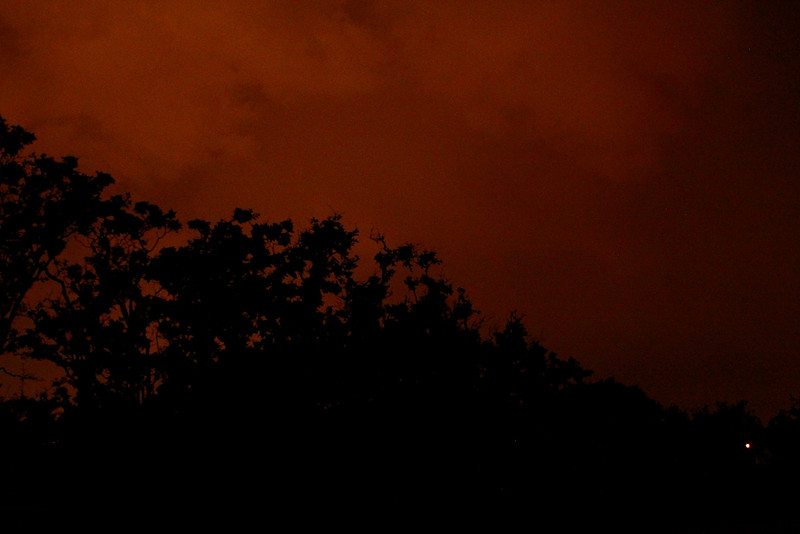
Red Skies at NightOne persistent issue with night photography in Victoria is the red light cast on the sky when doing long exposures along our eastern shore. Head out to Cattle Point or Cadboro Bay on any given cloudy night and try an exposure of five seconds or more. The result is always a reddish sky.
Shooting north from Cattle Point in Oak Bay during a thunderstorm
As usual, I first blamed Oak Bay for the problem, assuming that street lights in that gross red spectrum must be at fault. It made sense at the time as I'd seen many a prairie city glowing sickly orange from far off when on late night road trips. Despite this, I still needed to apply some critical thought to my theory, as using Oak Bay council as a catch all for assigning blame doesn't always stand up to scientific scrutiny. My theory quickly fell apart when examining some shots taken nearby Esquimalt's ugly orange lights. The cobalt blue skies of my long exposures taken there convinced me that my early assumptions had to be way off, so I looked around for a better explanation. The red navigation lights on the large towers off to the north were considered, but despite the prominence that height gives them, the total lumen output would be small compared to other red light sources in the area.
Shooting south from Saxe Point, Esquimalt. Note the total lack of red glow.
So what else does our eastern shore have that the west doesn't? Higher property tax assessments, more Volvos, and way less pickup trucks, but none of those have much affect on visible light. It had to be something else. The biggest clue though, came from the west.
Sunsets are red for one reason. When a light source disappears over the horizon, the longer wavelengths of the red light can travel furthest, remaining visible long after the other colours fade. While there isn't any sunset in the east, there are two large light sources over the eastern horizon at night, Vancouver and Bellingham. Neither are visible from our eastern shore, but both are just over the horizon, and both put out huge amounts of light. It makes sense to me that all the red light cast by them is more than enough to be adding that annoying red tinge to our long exposures.
How does one get rid of this light pollution? Asking Vancouver to turn out the lights after 9pm is impractical. They drive bad enough over there without getting rid of the street lights. A cyan filter absorbs red light and may be useful. Desaturating reds in post processing is easy, although I find that this just makes for a grey photo. In other words, we are just stuck with it.
Australian photographer Gary Ayton explains all this in great detail on his website, which is one of the most informative I've found on a subject that really isn't covered enough. Light pollution is just a fact of life in night photography, but we can take some solace in the fact that we are pretty lucky in Victoria, one of the few capital cities where you can look up and see the stars at night. We also get to blame most of our light pollution on someone else (Vancouver). One more thing for us to feel superior about besides better beer, lower crime, cleaner air, less traffic, better WHL team, and so on, and so on.
Don't Shoot me! Privacy rights & Model Releases in BC"You don't have my permission to publish that!" she yelled as I snapped off a few shots with my old T-70. It was the mid-90s, and she was being led out of a house packed full of pot plants by police officers. As a news photographer covering a story I had every right to submit the photo for publication, but it's rarely so simple. Fortunately for her, grow op busts in the area were so common that only the slowest news day would result in the photo being published.
There is nothing more confusing to a photographer as privacy laws, releases, and what rights the photographers and their subjects actually have. Things like focal length, shutter speed, and colour saturation are the same no matter where you are, or what language you speak. Who you can take a photo of, and where, can vary from country to country, province to province, and even from one town to another. Now, if you are a Canadian photographer taking pictures in another country and uploading them to your website hosted in the US, it gets even more complicated. It's enough to turn any photographer into a dedicated libertarian anarchist, purely as a result of too many rules.
Don't lose hope though. First of all, the laws are so vague and confusing that many are practically unenforcable, except in the most flagrant cases. Secondly, few of your subjects have the slightest clue what their actual rights are. This doesn't mean you can intentionally misuse their images, but it does buy you a bit of slack when you don't get it right 100% of the time.
Before I go too far, I need to point out that I'm not a lawyer, and this is just an opinion piece, not legal advice. When that person you've been following around taking pictures of has you arrested, do not bring me into it.
Speaking of following people around, let's address privacy. Before you worry about what rights you and your subject have concerning the image you shoot, you need to first consider if it's legal to take the shot in the first place. In Canada the law affords all citizens a reasonable right to privacy, and freedom from undue harassment. This comes down to manners basically. Regardless of what the law says, it's rude to intrude on anyone's personal space, and doing so with our cameras just contributes to mistrust of all photographers.
Criminal Code of Canada, 162. (1): (“Criminal Voyeurism”)
You may notice a lack of paparazzi in Canada. That's because their tactics are illegal here. You cannot chase or stalk people to get their photograph, and the subject being a public figure does not change that. News reporters can knock on someone's front door, but they can't camp out outside a home like they do in the US.
What if the person is in public? This get's a little vague, but it basically boils down to "prominent subjects". If you take a landscape, or streetscape photo, it isn't reasonable or possible for you to obtain a release from every recognizable figure. The scene is the subject, not any particular person. However if you are focusing on a street performer, a person sitting on a bench, or if any person or group of persons are the main subject matter then they are fair game to shoot, but the BC Privacy Act sets out several requirements for how the photo may be used, and what consent is required from the subject. Much of this depends on how you present the image, and what purpose you are using it for.
Privacy Act, 3.: (2) It is a tort, actionable without proof of damage, for a person to use the name or portrait of another for the purpose of advertising or promoting the sale of, or other trading in, property or services, unless that other, or a person entitled to consent on his or her behalf, consents to the use for that purpose.
(4) A person is not liable to another for the use, for the purposes stated in subsection (2), of his or her portrait in a picture of a group or gathering, unless the plaintiff is
So you can take a photo of the crowds in Bastion Square and use it for an advertisement about tourism without getting any releases, but not if any particular subject is emphasized (by depth of field, or selective colouring for example), or if a recognizable person is used, implying their endorsement.
Needless to say, all posed shots require consent of the subjects to use the image commercially. The same goes for anyone who is the focus of an image. Though a release form isn't a legal requirement, it's the best way to prove consent, and no reputable publisher will buy the image without one. If you really want to cover your bases, shoot a quick video clip on your phone of the subject giving you permission to use the photo. That way you have an iron-clad record of both written, and verbal consent from the subject.
One last thing, minors cannot give consent for their image to be used. Only their legal guardians can.
As you can see, I'm not one of those "Get a release for everything!" types. I think that adding too much paperwork discourages people from shooting. In reality, most people will never need a release. BC actually has pretty decent balance in it's privacy act, and affords the photographer a fair amount of latitude.
However there is one thing that getting that release signed does that has nothing to do with legalities. It forces the photographer to engage his subject on a human level, and from an artistic standpoint that greater understanding of the subject is of tremendous benefit.
For a very well written and in-depth guide to Canadian photography laws, the Ambient Light blog is a must-read. Much research for this post came from there, and sources they point to.
5 Reasons to Photograph Victoria in the WinterGrey skies, muted colours, long nights, and near constant rain. Why would anyone want to drag their cameras out these days? Well, if your gear is collecting dust in the closet, you're missing out on one of the best times of the year to shoot. In fact this time of year is almost tailor made for photographers, and here's why;
The Great Diffuser in the Sky - Take a few months to not worry about lens flare, harsh shadows, and every other issue that results from strong sunlight. That near constant veil of grey cloud overhead acts as an excellent diffuser. Try shooting some outdoor portraits in black and white. Notice how smooth the skin tones are compared to a sunny day in June. Overcast days also give you more constant light, with less moving shadows like the kinds resulting from the more typical cumulus clouds we encounter in the summer.
It's always "The Golden Hour" - Even on a clear winter day the sun is at a low angle in the sky for most of the day, casting a warm glow over everything. You can shoot most of the day in the same conditions you would only get during the early mornings, or late afternoons in high summer. You can now sleep in on your days off and still get lots of shooting time in.
In the Bleak Light, Colours Explode - Take a look around next time you are driving around on a cool, drizzly night. Notice something? In the muted light of a winter night, those colours that survive burst out of grey in a way they don't at any other time of the year. Signs, light displays, building windows lit from inside, all seem more vibrant amongst the grey tones that dominate the landscape. If you are a fan of adding a little colour to a black and white photograph, you can shoot colour photos and turn them black and white with only a minor desaturation in post processing, leaving those strong points of colour to emerge out of the grey.
Clearer Stars, Crisper Horizons - On clear nights outside the city you will find the skies in much sharper definition as the heat shimmer that radiates off the ground, making for wobbly light, is not present like it is in the summer. Even within the city it is greatly diminished. The longer, darker nights mean that you don't need to wait until almost midnight to have complete darkness.
No Crowds - Walk around your favourite architectural subjects, or streetscapes without having to deal with crowds of people walking through your shots. It's nice to shoot a vibrant street scene, but sometimes you want the buildings to be the focus, and that can be difficult with a bustling crowd surrounding it.
So get out there and challenge yourself to find the beauty of the city in the winter time. It's there for the inspired shooter. Before you go out though take a few minutes to read some advice from Jim Richardson on protecting your gear in the rain. http://photography.nationalgeographic.com/photography/photo-tips/taking-photos-in-rain-richardson/
Happy Shooting
Edit: Of course as soon as I post this we get 7 days of uninterrupted bright sun.
Newer Posts »
©2003-2018 Troy More Photography
|